Fig. 2.1
Part
2: Examination of the Mathematical Model
Fig. 2.1
Part
2: Examination of the Mathematical Model
As mentioned in the Introduction, the spirals that one sees are a purely geometric consequence of the fact that the botanical elements lie on the biologically more fundamental generative spiral. This theme will be pursued by means of a mathematical model consisting of:
a) a generative spiral going
inward, together with points at increments of f,
b) some of the associated
secondary spirals, which we call Fibonacci spirals.
The following very schematic description of the growth of the plant helps us understand why the botanical elements lie on a generative spiral as just described. In the growth of a sunflower seedhead, a more sophisticated scheme is needed (see XXXX below), but the present scheme provides a step towards understanding the more sophisticated scheme.
Simplified description of the growth of the plant
Fig. 2.1
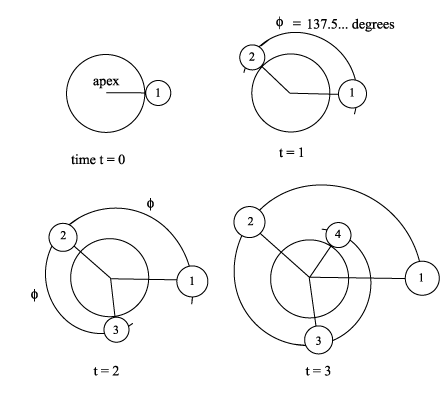
Plants which have Fibonacci spirals, or which have a visible generative
spiral, grow as follows. At the growing tip is a little disk-shaped mass
of cells called the apex, which is typically less than a millimeter
in diameter. Thus in this diagram we are loooking down at the growing tip
through a microscope. At regular time intervals, a clump of cells, called
a primordium, forms at the edge of the apex. We have chosen the
time scale so that the primordia appear at unit time-intervals. The primordium
migrates away from the apex while evolving into a botanical element such
as a branch (broccoli) or a bract (pine cone). More precisely, the growing
tip leaves the evolving primodium behind on the surface of the stem. The
surface of the stem is a cone with a very gradual taper. In the following
diagrams, this cone has been flattened out, first by increasing the diameter
of the base of the cone, then projecting onto a horizontal plane. Each
evolving primordium moves along a radius line. Thus primordium number one
moves horizontally to the right.
Fig. 2.2
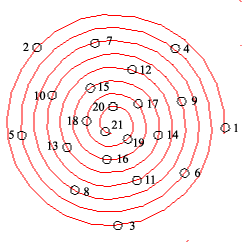
Here is the situation at time t = 20; in other words, the situation after 21 primordia have been formed. The magnification has been greatly reduced from that of Fig. 2.1.
The little circles represent the botanical elements; they are numbered
in the order of growth; i.e., the order in which they appeared at the edge
of the apex. Thus the numbers increase as we go inward on the generative
spiral.
Fig. 2.3a
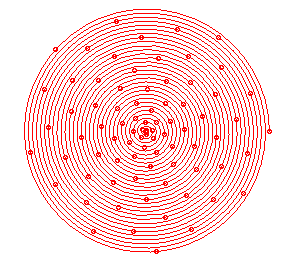
Here is the situation after 80 primordia have been formed. The magnification
has been further reduced.
Fig. 2.3b
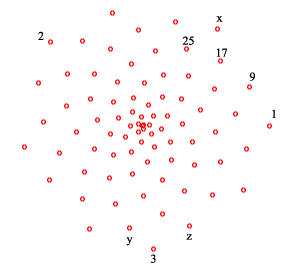 The contiuous
generative spiral is just a mathematical fiction that helps us keep track
of the botanical elements. We now remove the continuous spiral from the
preceding diagram in order to see better the points which represent the
botanical elements.
The contiuous
generative spiral is just a mathematical fiction that helps us keep track
of the botanical elements. We now remove the continuous spiral from the
preceding diagram in order to see better the points which represent the
botanical elements.
Can you see any families of Fibonacci spirals? There is a family of spirals going counterclockwise inward that is fairly easy to see. Elements number 1, 9, 17, and 25 lie on one of these spirals. How many spirals are in this family?
Problem XXX Determine the numbers x, y, z (cf. Fig. 2.2).
Do you see the family of 13 spirals going clockwise inward?
The two families just mentioned are indicated in the following two diagrams.
Fig. 2.3c

The points in the preceding diagram lie on 8 spirals.Proceeding inward
on any of the indicated spirals, if a point on the spiral has number n,
then the next point has number n+8. Because of this, and also because there
are 8 spirals in the family, let us say that these are the Fibonacci
spirals of order 8.
Fig. 2.3d
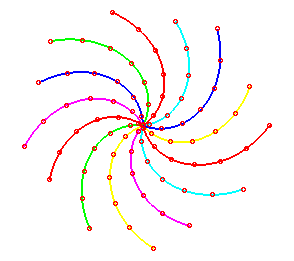
The points of Fig. 2.3d also lie on 13 spirals. These are the Fibonacci
spirals of order 13.
What
mathematical law should we use for the generative spiral?
The spiral in Fig. 2.1 (microscopic view of the apex) is an exponential spiral r = b*expt(n - cq), I think. (I used the spiral drawing facility in Adobe Illustrator). This is in keeping with the biological reality of growth near the apex. In Fig. 2.2 and 2.3 we used an Archimedian spiral r = c(h - q). The Archimedian law was chosen on the grounds of simplicity; it is the obvious choice for a preliminary study of the principal that as the generative spiral becomes shallow (small pitch) the higher-order Fibonacci spirals become visible.
Higher-Order
Spirals
When the generative spiral becomes shallower, the higher-order spirals become visible.
Fig. 2.5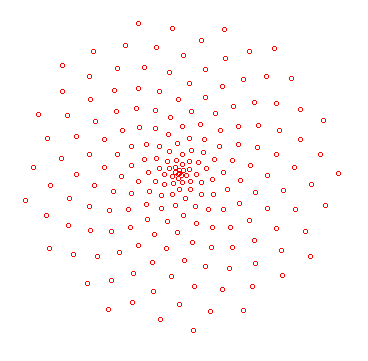
For n = 200 points, the Fibonacci spirals of order 21 (counterclockwise
inward) leap to the eye. The spirals of order 13 are also easy to see.
Fig. 2.6
The continuous Fibonacci spirals of order 13, k, and 21 are added to
the previous diagram.
Problem XXX: Determine the number k.
Fig. 2.7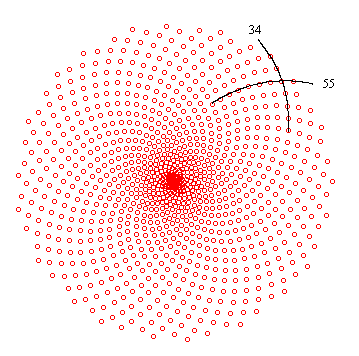
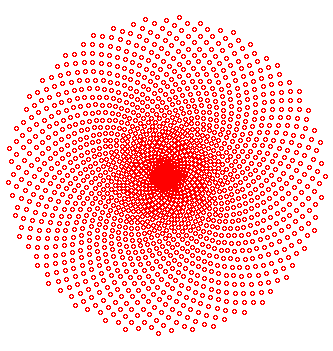
When the generative spiral becomes shallower still, even higher order
Fibonacci spirals emerge:
1000 points
Here there are 34 spirals going
clockwise inward, and 55 spirals going counterclockwise inward.
Fig. 2.8 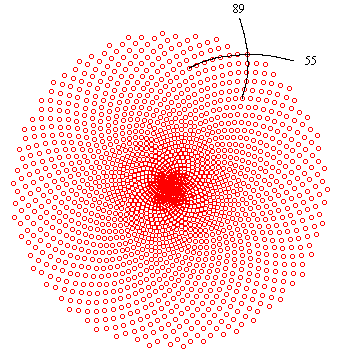
1800 points
The spirals of order 89 have
now emerged.
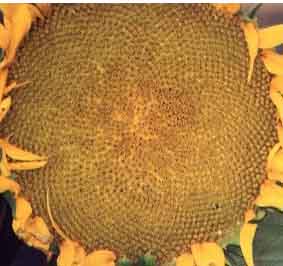
When the generating spiral in Fig. 2.7 is drawn clockwise, the resulting diagram shows the pattern of spirals in the sunflower in Fig. 1.6.
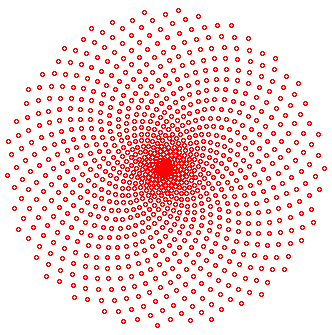

Similarly, when the generating spiral in Fig. 2.8 is drawn clockwise,
the resulting diagram shows the pattern of spirals in the sunflower in
Fig. 1.4.
 Here we draw
Fig. 2.8 with clockwise generating spiral, and we have and andand
we have
Here we draw
Fig. 2.8 with clockwise generating spiral, and we have and andand
we have